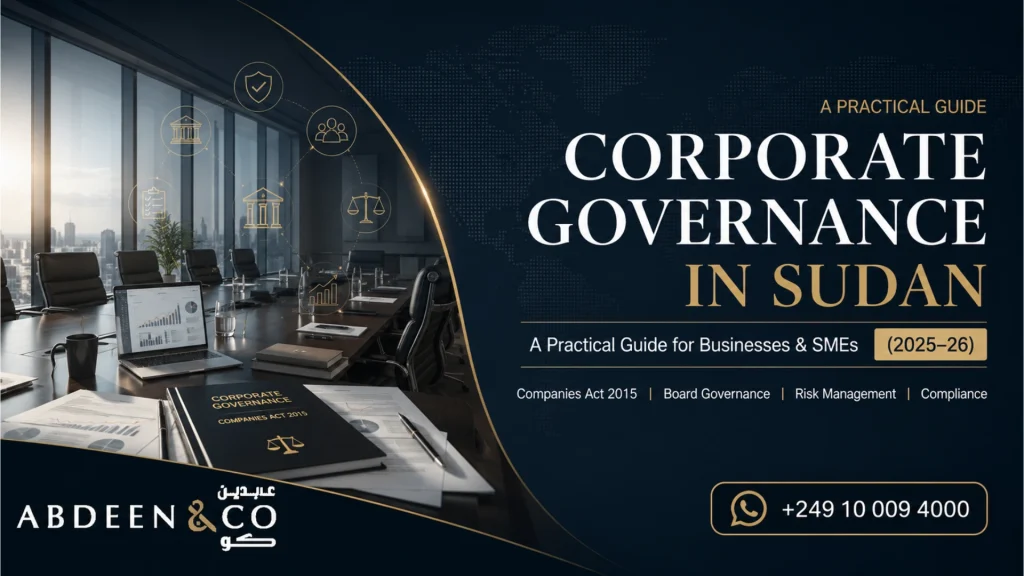
Corporate governance in Sudan is regulated primarily by the Companies Act 2015 (the principal statute governing company formation, governance, and liquidation) and the Commercial Register Regulations issued by the Ministry of Justice. Effective corporate governance rests on five pillars:(1) Leadership & Oversight, (2) Policies & Procedures, (3) Financial Controls, (4) Risk & Compliance, and (5) Stakeholder Engagement. For SMEs operating in Sudan — one of Africa’s most dynamic emerging markets — governance is not merely a compliance requirement but a strategic asset that determines access to finance, investor confidence, and long-term resilience. Abdeen&Co. has published a free Corporate Governance for SMEs Brief Book (2026) — a 34-page practical framework covering governance pillars, risk management, compliance, family business governance, ESG, and a 2026–2030 implementation roadmap.
Why Corporate Governance Matters for Businesses in Sudan
Corporate governance — the system by which companies are directed, controlled, and held accountable — is one of the most under-discussed yet commercially critical aspects of doing business in Sudan. Whether you are a newly registered company, an SME seeking investment, a family business planning succession, or a multinational structuring a joint venture, the quality of your governance framework directly determines your company’s access to finance, your legal exposure, and your long-term survivability.
Sudan’s business environment is changing rapidly. The PPP Law No. 10 of 2021, the Investment Encouragement Act 2021, and growing interest from Gulf investors have created a more demanding governance environment. Banks, development finance institutions (DFIs), and international joint venture partners increasingly require evidence of structured governance before committing capital. Companies that cannot demonstrate board accountability, financial controls, and compliance management are systematically excluded from the most valuable commercial opportunities in Sudan’s recovering economy.
This guide is prepared by the Corporate Services team at Abdeen&Co., drawing directly from our Corporate Governance for SMEs Brief Book (2026) — developed in partnership with 249Startups through the Sudan SME Catalyser Program. It covers the legal framework, the five pillars of governance, board structure, financial controls, risk management, family business governance, ESG, and the proprietary Abdeen&Co. GRC Framework™.
Free resource — download now: Abdeen&Co.’s Corporate Governance for SMEs Brief Book (First Edition, May 2026) is a free 34-page PDF covering 14 chapters, 5 governance pillars, and 4 proprietary models — including the SME Governance Maturity Model, Business Resilience Model, Institutional Readiness Index™, and Governance Self-Assessment Checklist. Designed for Sudanese businesses and informed by direct engagement with SMEs across diverse sectors.
1. The Legal Framework for Corporate Governance in Sudan
Corporate governance in Sudan is anchored in the following principal legal instruments:
- Companies Act 2015 — the primary statute governing company formation, registration, director duties, shareholder rights, financial reporting, and company liquidation in Sudan. All companies registered with the Commercial Registrar General operate under this Act.
- Commercial Register Regulations — issued by the Ministry of Justice, governing filing obligations, disclosure requirements, and Registrar compliance for registered entities.
- National Investment Encouragement Act 2013 (as amended 2021) — governing foreign investment structures, incentive regimes, and compliance obligations for foreign-owned entities.
- Sudan Labour Act — governing employment contracts, employee rights, and workplace governance obligations that form a core component of corporate compliance.
- Sudan Tax Authority Regulations — corporate income tax (35%), VAT (17%), and ongoing tax compliance form a mandatory component of any governance framework.
- Sector-specific regulations — banking (Central Bank of Sudan), telecoms, mining, energy, insurance, and pharmaceutical sectors each carry additional governance and reporting requirements.
Governance gap advisory: Sudan does not currently have a standalone Corporate Governance Code equivalent to the UK Corporate Governance Code or the OECD Principles of Corporate Governance. This means governance standards are largely self-regulated, with the Companies Act 2015 providing the minimum legal baseline. Abdeen&Co.’s Corporate Governance for SMEs Brief Book fills this gap by providing a practical, Sudan-specific governance framework aligned with international best practices.
Director Duties Under the Companies Act 2015
The Companies Act 2015 imposes specific duties on directors and officers of Sudanese-registered companies. These duties — which form the legal core of any governance framework — include:
- Duty of care: Directors must act with the skill, diligence, and care that a reasonably prudent person would exercise in the same role
- Duty of loyalty: Directors must act in the best interests of the company and its shareholders — not in their own personal interests
- Duty to avoid conflicts of interest: Directors must disclose and manage actual or potential conflicts of interest
- Duty to maintain proper books and records: All registered companies must maintain accurate financial records and make them available to shareholders on request
- Fiduciary duty: Directors hold company assets and decision-making authority in trust for the company — they may not misappropriate company resources
Abdeen&Co. advisory: Director liability exposure in Sudan is a real and growing risk — particularly as commercial disputes and international arbitration involving Sudanese companies become more common. Abdeen&Co.’s Corporate Services team advises boards on director duties, conflict of interest management, and board accountability frameworks — proactively, before a dispute arises.
2. The Five Pillars of Corporate Governance — The Abdeen&Co. Framework
Abdeen&Co.’s Corporate Governance for SMEs Brief Book identifies five foundational pillars of corporate governance that every Sudanese business — from a startup to a large corporate — should build its governance framework around. Weakness in any single pillar undermines the entire structure:
| 01Leadership& Oversight | 02Policies& Procedures | 03FinancialControls | 04Risk& Compliance | 05StakeholderEngagement |
Pillar 1 — Leadership & Oversight
The foundation of any governance framework is the quality and structure of its board of directors and senior management. For Sudanese companies, particularly SMEs, the most common governance failure is founder dependency — where all strategic and operational decisions flow through a single founder-director, creating a single point of failure for the business. Effective leadership governance requires:
- Clear board composition with defined roles — separating the Chairman from the CEO / Managing Director function
- A minimum of independent or non-executive directors to provide external oversight and challenge management assumptions
- Formal board meeting schedules — at least quarterly — with documented agendas, quorums, and minutes
- Documented delegation of authority matrices — defining who can authorise what expenditure, contracts, and decisions
- Board committees (Audit, Risk, Remuneration) for companies beyond the startup stage
Pillar 2 — Policies & Procedures
A governed company runs on documented policies, procedures, and operating standards — not on the memory or judgment of individual employees. Core documentation that every Sudanese company should have in place:
- Memorandum and Articles of Association — the constitutional document of the company (required under the Companies Act 2015)
- Shareholders Agreement — governing shareholder rights, exit provisions, pre-emption rights, and dispute resolution between shareholders
- Code of Business Conduct & Ethics — setting standards for anti-bribery, conflict of interest, confidentiality, and whistleblowing
- HR Policy Manual — aligned with the Sudan Labour Act, covering recruitment, contracts, leave, discipline, and termination
- Procurement and contracting procedures — essential for companies engaging in public contracts or PPP projects
- Data protection and confidentiality policy — increasingly important given digital transformation and cross-border commercial transactions
Pillar 3 — Financial Controls
Financial governance is the single area most closely scrutinised by banks, investors, and government counterparties in Sudan. Core financial control requirements:
- Separation of duties: the person who authorises a payment must be different from the person who processes it and the person who reconciles the account
- Annual audited financial statements prepared by a licensed Sudanese auditor — required for all registered companies and essential for bank lending, tax compliance, and investor due diligence
- Monthly management accounts — profit & loss, balance sheet, and cash flow — reviewed by the board
- Corporate bank account discipline: all company funds must flow through corporate accounts — mixing personal and company funds is a major governance failure that creates tax and dispute resolution risks
- Tax compliance registers: corporate income tax (35%) and VAT (17%) filings maintained in full with the Sudan Tax Authority
- Fixed asset registers and inventory controls — critical for companies involved in real estate transactions or capital-intensive operations
Pillar 4 — Risk & Compliance
Risk management and legal compliance are inseparable in Sudan’s business environment. Abdeen&Co.’s Corporate Governance Brief Book introduces a four-step Enterprise Risk Management (ERM) cycle that every company should implement:
| ERM Step | Description | Key Risk Categories for Sudan |
|---|---|---|
| 1. Identify | Map all material risks facing the company — legal, financial, operational, reputational, and market risks | Regulatory change, sanctions exposure, currency risk, political instability, supply chain disruption |
| 2. Assess | Evaluate each risk by likelihood and potential impact — create a risk register with colour-coded priority ratings | High: regulatory non-compliance, contract defaults; Medium: staff turnover, cybersecurity; Low: reputational |
| 3. Mitigate | Design and implement controls, insurance, contractual protections, and contingency plans for priority risks | Governance policies, legal contracts, insurance coverage, dispute resolution clauses, compliance registers |
| 4. Monitor | Review the risk register at each board meeting — risks in Sudan’s environment change rapidly | Quarterly ERM review; annual full risk assessment; immediate escalation protocol for critical risks |
Legal compliance forms the core of this pillar. Key compliance obligations for companies in Sudan:
- Commercial Registrar Annual Return — maintaining current information with the Commercial Registrar General
- Tax compliance — corporate income tax, VAT, employee withholding tax, and social insurance contributions
- Employment law compliance — formal contracts for all employees under the Sudan Labour Act; registration with the National Social Insurance Fund
- Intellectual property registration — protecting your brand through trademark registration and IP enforcement
- Sector-specific licences — where applicable (banking, mining, telecoms, insurance, pharmaceuticals)
- Sanctions compliance — Sudan-connected businesses must conduct sanctions screening. Abdeen&Co.’s Public International Law team advises on international sanctions compliance frameworks
Pillar 5 — Stakeholder Engagement
Effective governance requires structured engagement with all key stakeholders — not just shareholders. For Sudanese companies, stakeholders include employees, customers, suppliers, government regulators, community representatives, and — for larger companies — the public. Governance-level stakeholder engagement means:
- Annual shareholder meetings with proper notice, quorum, and voting procedures as required by the Companies Act 2015
- Employee communication frameworks — employment contracts, HR policy manuals, and performance management under the Sudan Labour Act
- Supplier contract management — written commercial contracts for all material supplier relationships
- Community and ESG engagement — for companies operating in communities affected by their activities (mining, agriculture, construction)
- Investor relations — for companies seeking bank finance or equity investment, regular financial reporting to lenders/investors is a governance requirement
3. Corporate Governance Challenges Specific to Sudanese SMEs
Abdeen&Co.’s engagement with Sudanese SMEs through the Sudan SME Catalyser Program (with 249Startups) identified five recurring governance challenges that, left unaddressed, prevent SMEs from accessing growth capital and surviving market shocks:
| Challenge | Description | Consequence | Abdeen&Co. Solution |
|---|---|---|---|
| Founder dependency | All decisions, relationships, and knowledge concentrated in one founder. No documented succession plan. | A company collapses or becomes unfinanceable if the founder departs, falls ill, or dies. | Board structure advisory; delegation of authority matrix; documented succession plan |
| Lack of documentation | Verbal agreements, undocumented processes, missing contracts, informal employee arrangements. | Unenforceable rights; loss in dispute resolution; tax exposure. | Commercial contracts; employment agreements; policy manual drafting |
| Weak financial controls | Personal and company funds mixed; no separation of duties; no audited accounts; cash-based transactions. | Disqualification from bank lending; tax liability; vulnerability to fraud; investor rejection. | Financial governance advisory; auditor introduction; account segregation protocols |
| No formal risk management | Risks identified intuitively rather than systematically; no risk register; no crisis response plan. | Inability to respond to regulatory changes, supply chain disruptions, or contract defaults. | ERM framework; risk register template; GRC implementation |
| IP & brand vulnerability | Trading names, logos, and product innovations not registered. No IP licensing or protection agreements in place. | Brand infringement; inability to license or franchise; IP theft without recourse. | Trademark and patent registration via Equity IP Sudan / Abdeen&Co. — see abdeenandco.com/intellectual-property |
4. The Abdeen&Co. GRC Framework™ — Governance, Risk & Compliance in Sudan
Abdeen&Co.’s proprietary GRC Framework™ — published in full in the Corporate Governance Brief Book — integrates governance, risk management, and compliance into a single operational system for Sudanese businesses. Unlike generic governance frameworks designed for large Western corporations, the Abdeen&Co. GRC Framework™ is calibrated to:
- The reality of fragile-environment operations — Chapter 13 of the Brief Book specifically addresses governance during conflict and recovery, directly applicable to Sudan’s current context
- SME resource constraints — the framework is scalable, with minimum viable governance requirements for each stage of company growth (startup → growth → maturity → institutional readiness)
- Sudan’s specific legal requirements — the Companies Act 2015, Labour Act, tax regulations, sector licences, and PPP Law are all mapped to relevant governance controls
- Three-jurisdiction coverage: Sudan · UAE · England & Wales — relevant for companies with cross-border operations or UAE-Sudan structures
The SME Governance Maturity Model: Abdeen&Co.’s Brief Book introduces a five-level Governance Maturity Model — from Level 1 (Compliance Foundation) to Level 5 (Leading Practice). Each level sets specific governance targets that correspond to progressively larger business milestones: formal registration, access to bank finance, DFI readiness, institutional investment, and public procurement eligibility. The Governance Self-Assessment Checklist included in the Brief Book allows any business to self-score against the maturity model and identify priority gaps.
5. Family Business Governance in Sudan
A significant proportion of Sudanese businesses — particularly in sectors such as food and agribusiness, construction and engineering, transport and logistics, and banking and financial services — are family-owned businesses. Family businesses face distinct governance challenges that standard corporate governance frameworks do not adequately address:
- Succession planning: absence of a documented succession plan is the most common cause of family business collapse across generations. Under Sudanese company law, the death of a founding shareholder-director may create significant legal and operational disruption if succession is not pre-planned
- Family conflict management: disputes between family members over company direction, profit distribution, and decision-making authority are a primary driver of commercial litigation in Sudan’s courts
- Separating family and company finances: many Sudanese family businesses treat company funds as a shared family resource — a practice that creates serious tax, governance, and dispute resolution risks
- Non-family professional management: integrating non-family professional managers alongside family directors requires formal governance structures that define authority, accountability, and reporting lines
Abdeen&Co. family business governance tools: Chapter 7 of the Corporate Governance Brief Book covers three specific instruments for family business governance in Sudan: (1) the Family Constitution — a legally binding document governing the relationship between the family and the company; (2) the Family Council — a governance body separate from the company board for family-level decisions; and (3) a Succession Planning Protocol — documenting the phased transfer of leadership and ownership. Abdeen&Co.’s Corporate Services team drafts all three instruments.
6. ESG & Sustainability Governance for Sudanese Businesses
Environmental, Social, and Governance (ESG) considerations are no longer optional for Sudanese businesses seeking international finance, Gulf investment partnerships, or involvement in PPP and infrastructure projects. Development Finance Institutions (DFIs), Islamic banks, and multinational joint venture partners increasingly screen investments against ESG criteria. Sudan-specific ESG requirements include:
Environmental Governance
Companies involved in mining and natural resources, energy and renewables, construction and infrastructure, and agriculture must maintain environmental compliance documentation, conduct Environmental Impact Assessments (EIAs) where required, and include environmental risk management in their board-level risk register.
Social Governance
Social governance encompasses employment law compliance, community engagement, and supply chain standards. For companies involved in PPP concession agreements or large-scale project finance, formal community consultation and social impact assessment are increasingly required by international project lenders and development institutions.
Digital Governance & Cybersecurity
Chapter 8 of the Abdeen&Co. Corporate Governance Brief Book addresses digital governance and cybersecurity as a board-level responsibility. As Sudanese companies increasingly operate digital platforms, process customer data, and engage in e-commerce and digital banking, data protection policies, access controls, and incident response plans are becoming governance essentials. For companies handling intellectual property or proprietary technology, digital governance is particularly critical.
7. How Abdeen&Co. Advises on Corporate Governance in Sudan
Abdeen&Co.’s Corporate Services team provides comprehensive corporate governance advisory for businesses across all stages of development — from company registration and formation through governance framework implementation, board structuring, compliance management, and dispute resolution. Our governance advisory services include:
| Service | What We Provide | Relevant Practice Area |
|---|---|---|
| Corporate formation & governance foundation | Companies Act 2015-compliant MoA/AoA drafting; Commercial Registrar registration; initial board structure; shareholders agreement | Corporate Services |
| Board governance advisory | Director duties training; delegation of authority matrix; board meeting procedures; conflict of interest protocols; independent director recruitment advisory | Corporate Services |
| Commercial contracts & policies | Shareholder agreements; commercial contracts; HR policy manuals; code of conduct; procurement policies; supplier agreements | Commercial Transactions |
| Employment law compliance | Employment contracts under Sudan Labour Act; social insurance registration; HR policies; employment tribunal representation | Employment Law Advisory |
| IP protection & governance | Trademark, patent and copyright registration through Equity IP Sudan; IP licensing agreements; brand protection strategy | Intellectual Property |
| Risk management & GRC | Enterprise risk register; GRC Framework™ implementation; sanctions compliance review; regulatory compliance audit | Corporate Services / Public Int’l Law |
| Real estate governance | Property acquisition due diligence; title verification; lease agreements; land registration; property dispute resolution | Real Estate Transactions |
| Construction governance | FIDIC contract review; subcontractor agreements; claims management; construction dispute resolution via CDMAC arbitration | Construction & Engineering Law |
| Family business governance | Family constitution; succession planning; family council structure; share transfer documentation | Corporate Services |
| PPP & project governance | PPP Law compliance; project company formation; BOT/BOOT contract review; regulatory approvals; project finance governance | Project Finance & Development |
For Sudanese and UAE-Sudan companies at any stage of development, Abdeen&Co. provides governance health checks — a structured legal review of your existing governance documents, compliance status, risk exposure, and board structure — with a prioritised action plan for closing governance gaps. Our team includes Dr. Mohamed Abdeen (Managing Partner, 23 years), Ms. Islam Bakri (Deputy Managing Partner and Head of Corporate), Mr. Bart Fisher (Partner Off Counsel — Banking & Finance), and Mr. Gregory Ewing (Counsel Partner) — providing multidisciplinary coverage across corporate, commercial, banking, and governance matters. See our firm’s track record and sector experience.
Frequently Asked Questions
Q: What law governs corporate governance in Sudan?
Corporate governance in Sudan is primarily governed by the Companies Act 2015 — the principal statute governing company formation, director duties, shareholder rights, financial reporting, and company liquidation. Additional governance obligations arise from the Commercial Register Regulations (Ministry of Justice), the Sudan Labour Act (employment governance), and sector-specific regulations applicable to banking, mining, telecoms, insurance, and pharmaceuticals. Sudan does not currently have a standalone Corporate Governance Code, making Abdeen&Co.’s Corporate Governance for SMEs Brief Book (2026) a practical governance reference for Sudanese businesses.
Q: What are the five pillars of corporate governance for businesses in Sudan?
The five pillars of corporate governance identified in Abdeen&Co.’s Corporate Governance for SMEs Brief Book are: (1) Leadership & Oversight — board structure, director duties, and delegation of authority; (2) Policies & Procedures — constitutional documents, codes of conduct, HR manuals, and operating procedures; (3) Financial Controls — separation of duties, audited accounts, tax compliance, and cash management; (4) Risk & Compliance — enterprise risk management, regulatory compliance, and sanctions screening; and (5) Stakeholder Engagement — shareholder meetings, employee communication, supplier contracts, and community engagement.
Q: What are the main corporate governance challenges for SMEs in Sudan?
Abdeen&Co.’s engagement with Sudanese SMEs through the Sudan SME Catalyser Program identified five recurring governance challenges: founder dependency (all decisions concentrated in one person); lack of documentation (verbal agreements, missing contracts, informal HR arrangements); weak financial controls (mixed personal and company funds, no audited accounts); absence of formal risk management; and intellectual property vulnerability (unregistered brands, logos, and innovations). Each of these challenges has direct commercial consequences — preventing access to bank finance, creating dispute risk, and undermining investor confidence.
Q: What is Abdeen & Co. GRC Framework™?
The Abdeen&Co. GRC Framework™ is a proprietary Governance, Risk & Compliance framework developed specifically for businesses operating in Sudan and fragile-environment contexts. Published in the Corporate Governance for SMEs Brief Book (May 2026), it integrates all five governance pillars with a four-step Enterprise Risk Management cycle (Identify, Assess, Mitigate, Monitor) and a comprehensive compliance management system. The framework is calibrated to Sudan’s specific legal requirements — Companies Act 2015, Labour Act, Tax Authority regulations, and sector licences — as well as the UAE and England & Wales jurisdictions for cross-border entities.
Q: How does corporate governance affect access to finance in Sudan?
Corporate governance directly determines whether a Sudanese business can access bank lending, development finance (DFI), or equity investment. Banks and DFIs require audited financial statements, formal board structures, documented compliance systems, and evidence of risk management before approving facilities. Companies without these governance elements are systematically excluded from formal financing. The Abdeen&Co. Institutional Readiness Index™ (included in the Corporate Governance Brief Book) provides a practical scoring framework for assessing and improving finance readiness.
Q: What is family business governance and why does it matter in Sudan?
Family business governance is a specialised branch of corporate governance addressing the specific challenges of businesses owned and managed by family members — including succession planning, family conflict management, separation of family and company finances, and integration of non-family professional managers. In Sudan, where a significant proportion of businesses are family-owned across sectors such as construction, agriculture, transport, and trading, absence of family governance structures is a primary driver of business failure across generations. Abdeen&Co.’s Corporate Services team drafts Family Constitutions, Family Council structures, and Succession Planning Protocols under Sudanese law.
Q: What does Abdeen & Co. Corporate Governance for SMEs Brief Book contain?
The Abdeen&Co. Corporate Governance for SMEs Brief Book (First Edition, May 2026) is a free 34-page PDF covering 14 chapters and 5 governance pillars. It includes: the five-pillar governance framework; the four-step Enterprise Risk Management cycle; compliance management systems for corporate, tax, employment, and regulatory obligations; Chapter 7 on family business governance (family constitution, family council, succession planning); Chapter 8 on digital governance and cybersecurity; Chapter 10 — the SME Governance Maturity Model (5 levels); Chapters 11–12 — policy recommendations and a 2026–2030 implementation roadmap; Chapter 13 — governance in fragile environments; and Chapter 14 — the full Abdeen&Co. GRC Framework™. The book is available free at abdeenandco.com.